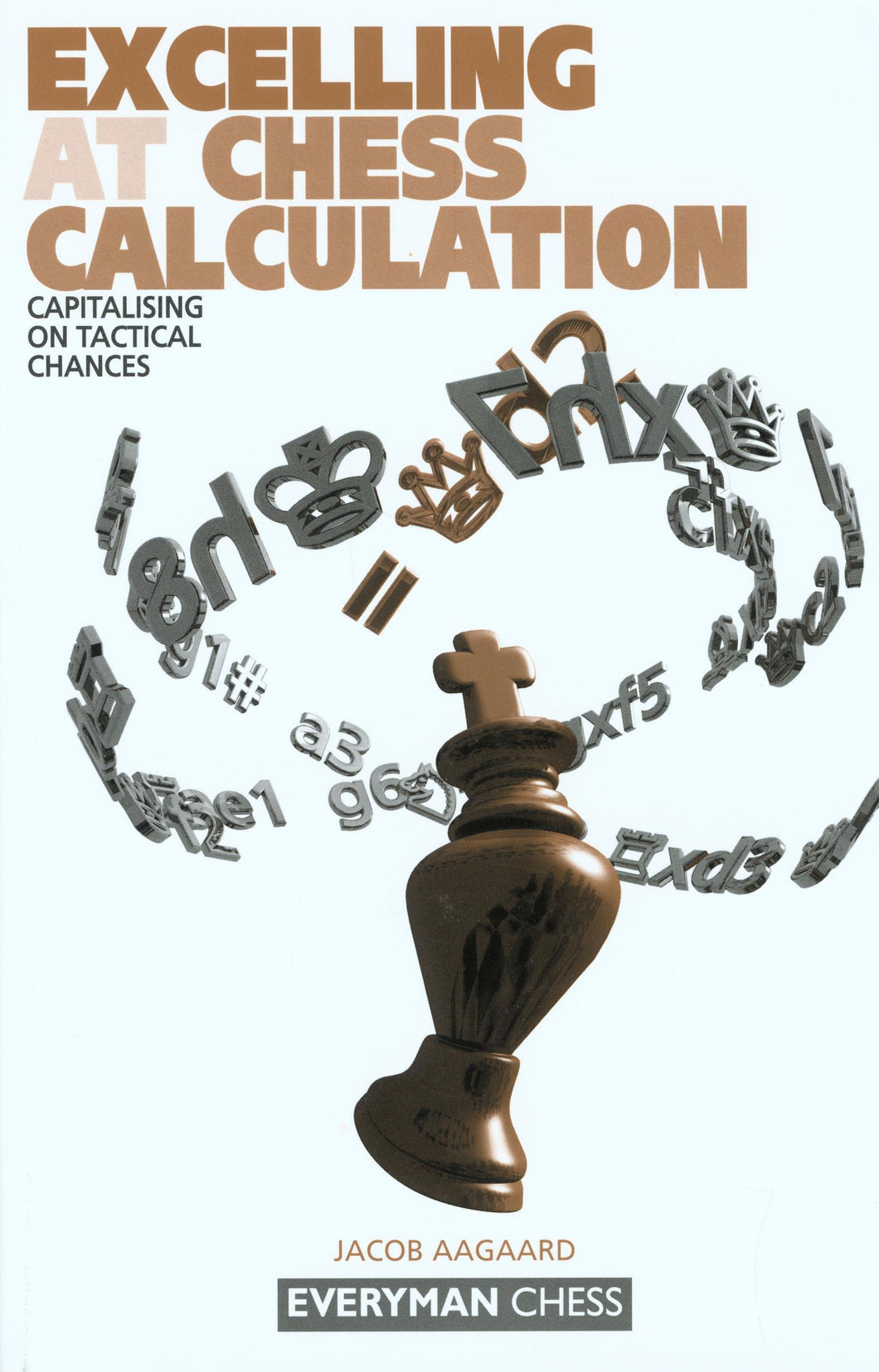
Chess calculation is a core skill in chess. Some say it's the most important skill, and that the ability to calculate deeply and accurately is the best predictor of playing strength. Thus, getting better at calculation should be a top priority for any improving player. So when I found the book Excelling at chess calculation, I felt that this should be a no-brainer. Let's take a look at this book!
Each of the eight chapters in the book tease the reader into thinking that s/he will learn something profound about the topic that is indicated by the header, but after a page or so of general introduction, the realization slowly dawns that the promise will be left unfulfilled. For example chapter 8 is titled "How to train calculation" - arguably a central topic for this kind of book. The chapter outlines five main options: (1) Work out candidate moves, (2) do combinations, (3) work on pawn endgames, (4) solve studies and (5) analyze complicated positions. And that's about it! The chapters provides argumentation for why these types of exercises are useful, but gives little to no guidance for how to do them.
By now, my disappointment with this book should be all too clear. But I was not disappointed because it is a bad book. Rather, my objection is that it simply does not cover the topic of calculation training - at least not to the extent that one would expect. Instead, it is really a collection of annotated games. This being said, the annotations are great, and the games are interesting. So although the book does not fulfil its promise, it is still well worth reading.
What can you expect from this book?
Let me be upfront. When I was done reading this book, I was quite upset. The content does not fulfil the promise of the title - not even close. Upon writing this review, I went through the book again, just to check if I got a different impression. In one way, I didn't, but in another way I did. Let me explain.
"A crucial guide to the skill of chess calculation. Ideal for both club and tournament players." That's what the back cover says, and I had heard people recommending the book. My expectations were high and I was excited when the book arrived in the mail. Unfortunately, after getting halfway through the book, I came to the conclusion at least one of these statements is incorrect. As a club player, I felt that I did not learn much about chess calculation from this book. So either it's not for club players like me, or it simply isn't a guide to the skill of chess calculation. Either way, if you are a club player and want to develop your calculation, I would recommend other books.
It is important to develop our feeling for the critical moments in chessThe quote above is an example of the many truisms in the book. It is difficult to disagree with this statement. Another example is Aagaards answer to one of the most common questions from chess players: "How much should I calculate?" And his answer? "Not more than the position requires". Well, this would perhaps be a helpful comment if the reader was given some tools to determine the amount of calculation that is required by a given position. The same goes for developing a "feeling for the critical moments". But here, the book fails to deliver.
Each of the eight chapters in the book tease the reader into thinking that s/he will learn something profound about the topic that is indicated by the header, but after a page or so of general introduction, the realization slowly dawns that the promise will be left unfulfilled. For example chapter 8 is titled "How to train calculation" - arguably a central topic for this kind of book. The chapter outlines five main options: (1) Work out candidate moves, (2) do combinations, (3) work on pawn endgames, (4) solve studies and (5) analyze complicated positions. And that's about it! The chapters provides argumentation for why these types of exercises are useful, but gives little to no guidance for how to do them.
By now, my disappointment with this book should be all too clear. But I was not disappointed because it is a bad book. Rather, my objection is that it simply does not cover the topic of calculation training - at least not to the extent that one would expect. Instead, it is really a collection of annotated games. This being said, the annotations are great, and the games are interesting. So although the book does not fulfil its promise, it is still well worth reading.
Who should read this book?
As stated above, if you are looking to improve your calculation skills, this is probably not the best book for you. However, if you are looking for a book with interesting and well annotated games, this is an excellent choice. I believe that readers of all levels may get something out of the book, but the content is probably best suited for readers with a playing strength above 1700 Elo.
About this book
| Author: | Jacob Aagaard |
| Title: | Excelling at chess calculation |
| Type of book: | Game collection |
| Level: | Intermediate/Advanced |
Out of curiosity, what is your current rating?
ReplyDelete