
Bobby Fischer goes to war

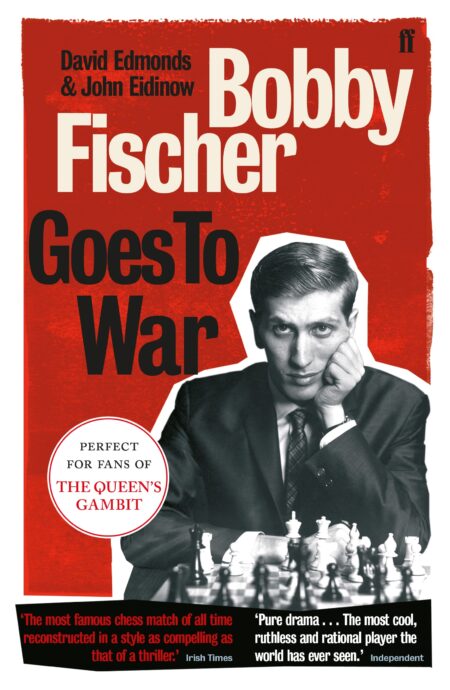
I recently read and reviewed a book about the Fischer-Spassky match. While reading that book, I came across several references to another book on the match. So in order to properly commemorate the match, I decided to read one more. It is also considered to be one of the best books on the match, so I thought it should be worth it.

If you like these reviews, please consider supporting my work. Visit my patreon page for details.
Become a Patron!
What can you expect from this book?

If you are looking for a book on the Fischer-Spassky match, look no further. That is, unless you're looking for a book on the chess itself. Because this book has hardly any chess in it whatsoever. This means that the book does not require any knowledge about chess.

Bobby Fischer goes to war is a pure biography on the world championship match of 1972. The book covers the events before, during and after the match. 

Unlike The Match of All Time, this book does not give a history of chess or the world champions. In the beginning of the book, there is a list of all champions up to 1969. Just names and years, that's it. 

The book begins with a short biography of both players and then covers the tournaments that paved the way for Fischer's opportunity to challenge Spassky for the crown. The rest of the book is about the drama surrounding the tournament and the aftermath. The book describes not only what happened to Fischer after the match, but also how the outcome affected Spassky, which is quite interesting.

Overall, the book is has a logical (and chronological) structure, and it is well-written. So if you are looking for a book on the drama around this famous match, this is probably the book for you. But if you are looking for analysis of the chess games, you will not find it here.

Who should read this book?

This is a book for anyone who is interested in the history of chess, and especially the famous match between Fischer and Spassky. It is really well-written and quite entertaining. I can recommend it to anyone who is interested in the drama around what has been dubbed the match of the century.

About this book

Author:David Edmonds and John Eidinow
Title:Bobby Fischer goes to war
Type of book:Biography
Level:Any

Comments

Popular reviews

Judgement and planning

Some books "fly under the radar" and do not get the same attention as the evergreen classics. But sometimes, there is gold in old mines. And I found a little golden nugget while shopping for used books. A book written for amateurs, by (arguably) the best amateur of all time; former world champion Max Euwe. Sounds promising, right? If you like these reviews, please consider supporting my work. Visit my patreon page for details. Become a Patron! What can you expect from this book? In my previous review of Chess Fundamentals , said that few world champions have written books for beginners and intermediate players. Capablanca is, of course, one exception. And another is Max Euwe. Euwe is not the most well-known world champion. He was in his prime in the 1930s and 1940s, most notably in 1935 when he dethroned none other than the great Alexander Alekhine. Although many have suggested that Alekhine only lost because of heavy use of alcohol, beating him is no small feat (rega...

Nunn’s secrets

Let me tell you a secret. There is no such thing as 'the best chess books'. It all depends on the preferences and expectations of the reader and of course the work s/he puts in when working with the book. So just because someone else claims that a certain book belongs in the 'best books of all time' category, it does not necessarily mean that it is a book that you will appreciate. This little intro may have given away the content of this review, but that's ok. Secrets of practical chess is an example of a book that has gotten a lot of praise on a more than one occasion. So let's dig in and see what the fuss is all about. What can you expect from this book? Secrets of practical chess has seemingly been well received in the chess world. Overall, the opinions are very positive. John Watson gave it a very positive review , and Jacob Aagaard has listed it among the top 10 books of the 20th century . It is also mentioned in another list of 'best' books ....

Thoughts on chess improvement

I was recently interviewed by Kevin Scull  for his podcast  Chess Journeys: Tales of Adult Improvement . When I got the request, I started thinking about what I have to contribute with in terms of improvement advice for chess players. I ended up creating a mindmap of it all, and thought I would share it with you along with an elaboration of what it means. Three questions for you In my opinion, there are three main questions that you need to ask yourself in order to find your  path to chess improvement: Why am I doing this? What will I focus on? How will I study? I have tried (and failed) myself, many times. And what I've realized is that you cannot copy other people's plans for improvement; you need to create a personalized plan that is adapted to your goals, your needs and your general life situation. Don't copy other people's improvement plans Start with WHY I've seen a lot of adult players describe their chess goals. Almost all of them are defined in...

Lessons from a legend

What if you could get chess lessons from a former world champion? Would you say yes? This is a question that Kostya Kavutskiy asked in a recent video . I decided to accept that offer, and during the past few weeks, I've spent some quality time with the third world champion, José Capablanca. In his 100 year old book, he outlines some of the most important principles of chess. If you haven't already read this book, maybe you should? Hopefully, this review will help to decide if this book is for you. If you like these reviews, please consider supporting my work. Visit my patreon page for details. Become a Patron!   What can you expect from this book? Several world champions (most of them?) have written books for advanced players. Capablanca is one of the few who have written chess books for beginners and intermediate players. And his book Chess Fundamentals  is a classic introductory book. Many people have recommended it, and I've had it on my reading list for a long time...

My system should be your system?

One of the greates classics of chess literature. That's at least what it says on the cover. But let's not judge a book by the cover. Instead, we could listen to what others have said about this book. In his review of My system , John Watson writes: "We no longer consider many classics to be essential to a chess education, not since the Internet; but if there’s an exception, Nimzowitch’s work is it". These are big words from a big man. Watson is an authority of chess theory, so his evaluation should not be taken too lightly. Although My system has frequently been mentioned among the greatest books of all time, and has been recommended by many players , it has also been the subject of controversy. Of course, when the book was first published (almost 100 years ago), many ideas in the book challenged many of the established principles of chess theory at the time, and other authorities dismissed the ideas. But also to this day, many people are unimpressed with the b...