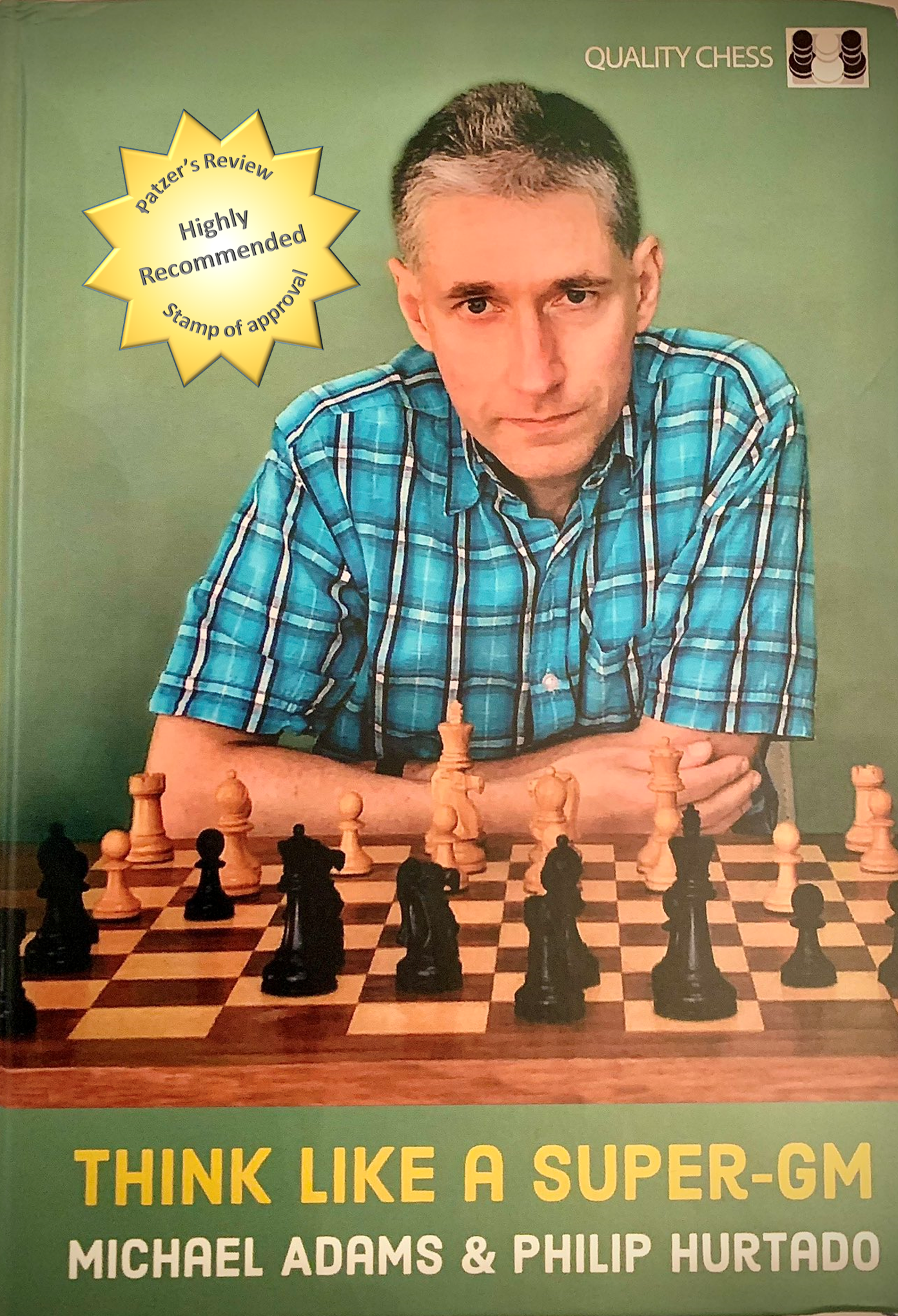
In my previous review I mentioned how I would like to see an improved version of The Improving Chess Thinker, and that a book had recently come out that seemed to be perfectly in line with my ideas. A few months later, I have bought the book, worked through the exercises and read the prose. And finally, I am ready to give my complete review of the new book Think like a Super-GM. And I can tell you, I was not disappointed by this book. Read on to find out why you should probably get the book too.
If you like these reviews, please consider supporting my work. Visit my patreon page for details.
Become a Patron!
The first chapter gives an introduction to the book, just as you would expect. It oulines the contents and how to use the book. The most valuable part here is chapter 1.6 where Michael Adams gives some tips for solving the puzzles. Rereading this part after having worked through the book, I realize that I should probably have read that part more carefully before digging in. But then again, I probably understand it better now, after having felt the consequences of making the mistakes he points to. You learn the most when it hurts!
If you like these reviews, please consider supporting my work. Visit my patreon page for details.
Become a Patron!
What can you expect from this book?
As the title indicates, Think like a Super-GM is a book about thinking in chess. At its core, it is a puzzle book. But it is more than that. In the chapters surrounding the puzzles, the book digs into the challenges of thinking in chess and how the thinking process differs between players of different levels.The first chapter gives an introduction to the book, just as you would expect. It oulines the contents and how to use the book. The most valuable part here is chapter 1.6 where Michael Adams gives some tips for solving the puzzles. Rereading this part after having worked through the book, I realize that I should probably have read that part more carefully before digging in. But then again, I probably understand it better now, after having felt the consequences of making the mistakes he points to. You learn the most when it hurts!
The puzzles are presented four at a time. You are only given the positions and which side has the move; no other hints of any kind. On the pages following the puzzle positions, there are some examples of analyses from players of different strength, and finally a deeper analysis by Adams. You can see a few examples in the excerpt provided by the publisher.
This structure is exactly what I felt was missing in The Improving Chess Thinker. I think it is very instructive to see how other players view the position and to follow their thought processes. This allows you to compare your own thought process to other players and also compare the type of thought patterns that occur at different levels.
One thing that I really like about the book is how the solutions section is structured. Michael Adams has analyzed each position carefully and checked the lines with an engine. Of course, he gives a complete analysis of the main line. But he also comments on the most common suggestions by the subjects who have attempted the puzzles. So if you've arrived at an incorrect conclusion and maybe don't understand the position completely, chances are you will get an explanation why your move doesn't work or why it's an inferior solution.
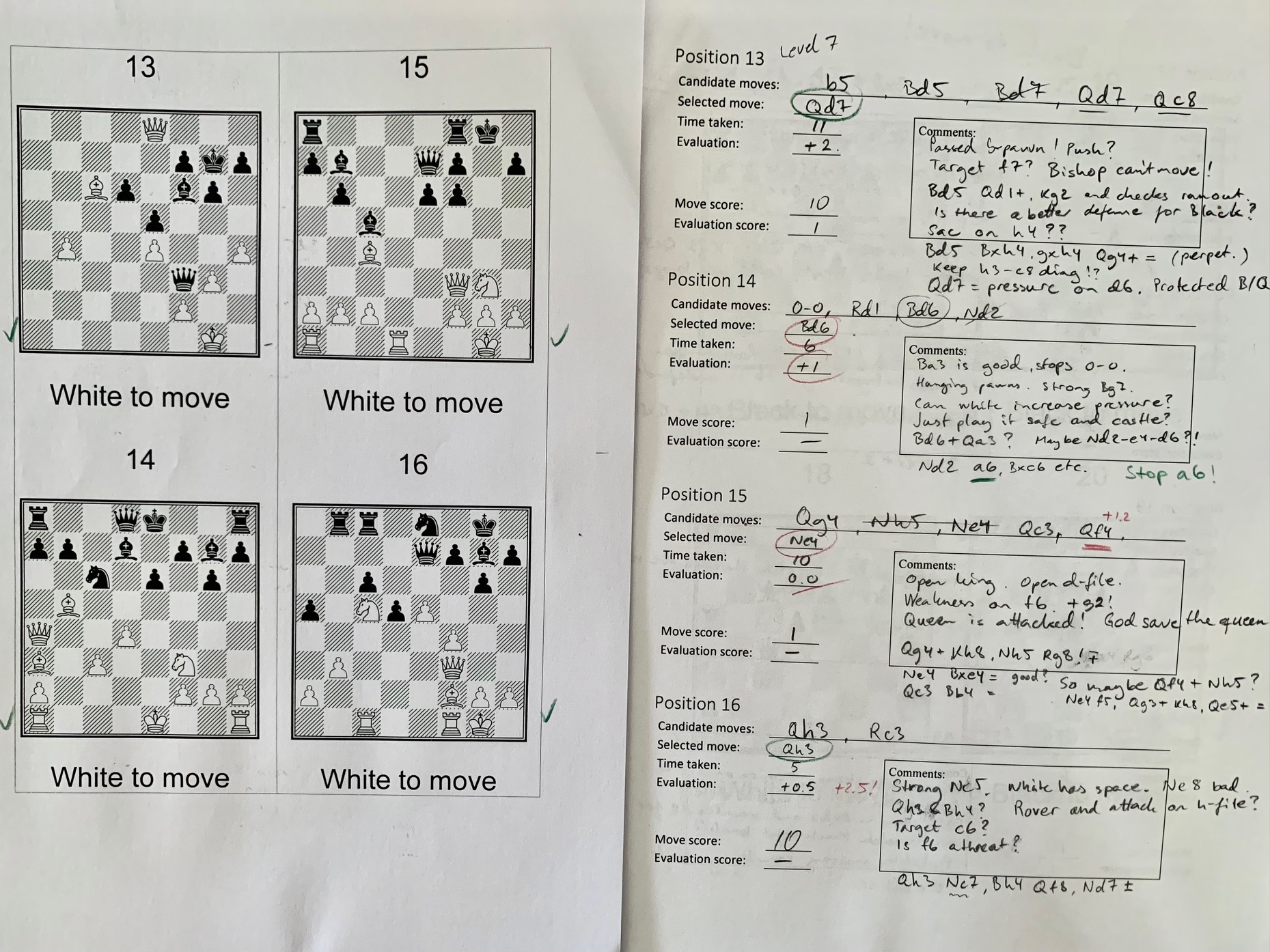
In order to get the most out of the book, I suggest that you document your thought process when working through the puzzles. I suggest that you write down your thoughts on a computer or paper, or verbalize your analysis and record yourself. I decided quickly that I wanted to write down my analyses, and created a study companion in which I could easily access the positions and record the relevant information. The image below gives an example of my own analyses of positions 13-16.
 |
| Example from study companion |
The tips given in chapter 1.6 are deepened even further in chapter 4, where both authors draw conclusions from the experiment and give a more detailed account of how a grandmaster approaches a chess position.
Finally, the book is concluded with an eyetracker experiment, where a few players were asked to analyze chess positions while their eye movements were recorded. This part is very interesting in itself, but feels slightly off from the rest of the book.
There is really only one minor detail that I think could have made the book even better. In the image below, I have illustrated the computer evaluation of the 40 puzzles in the main section of the book. The evaluation is relative, so that a negative score (e.g. -1.5) is positive when Black has the move.
 |
| Computer evaluation of puzzle positions |
As you can see from the graph, most of the puzzles are about finding winning combinations or a continuation that maintains an edge for the player that has the move. Only 3 of the 40 puzzles are aimed at defensive play and playing for equality. In my opinion, this could have been slightly more balanced.
In terms of difficulty, the book is very clearly biased towards higher levels. The puzzles are graded from 1-10, where 10 is the most challenging. The average puzzle level is just above 7, and only 4 puzzles are rated below 6. This indicates that the book is mainly written for a somewhat advanced audience. However, players at lower levels can still benefit from the book, but perhaps using it more as instruction than a puzzle book.
Overall, Think like a Super-GM is an excellent book. It has helped me improve my analytical skills and pay more attention to the opponent's defensive resources. I think the book is very well written and the level of detail in the analyses (solutions) has a reasonable level of details (depth and number of lines). It is definitely one of the best puzzle books I have seen, and I can wholeheartedly recommend it to anyone.
Who should read this book?
Think like a Super-GM is a book for a wide range of audiences. Being an intermediate player myself, I felt that the book was at a perfect level. However, I have also heard very strong players reporting that they enjoy the book. As there are very few "simple" puzzles in the book, I think that beginners will find it a bit too challenging. This being said, the solutions are very instructive, so the book could well be read as pure instruction. In my opinion, you should benefit the most from the book if you are rated in the 1400-2200 range. So if that is you, I strongly recommend that you get this book (and work through it!). But as indicated above, the book could be useful for players of all levels.About this book
| Author: | Michael Adams & Philip Hurtado |
| Title: | Think like a Super-GM |
| Type of book: | Chess improvement, Middlegame, Tactics |
| Level: | (Beginner), Intermediate, Advanced |
Comments
Post a Comment